


Throughout history, a specific style would dominate architecture and the arts for centuries. Just think of the Romanesque, Gothic, Renaissance, Baroque, or Neoclassical styles. However, in the 20th century a major change occurred. As the world was preparing to embrace modern architecture, several unique styles appeared in different corners of Europe.
The most famous of these styles is Art Nouveau. It spread across the continent in various forms known as Secession, Modernismo, Liberty, Jugendstil, or the Arts and Crafts movement. But it was not the only one. Other movements, such as Czech Cubism, German Expressionism, the Amsterdam School, and Art Deco, were also successful in elevating architectural decoration to a new level.

Catalan Modernism in Barcelona
Catalan modernism was the topic of my first architecture post. I’ve been living in Barcelona for the last 12 years admiring its beautiful architecture. In my opinion nothing distinguishes Barcelona as much as the so called ‘Catalan Modernist’ buildings. These are the Catalan interpretation of the world known Art Nouveau style, and there are tons of them all over the city.
In Barcelona buildings have more decorations, colors and shapes than anywhere else. In fact, these masterpieces blend Gothic and Moorish architecture perfectly with Catalan creativity. The style was dominant at the turn of the 20th Century when Barcelona was flourishing, thus its lavish design.

Cubist Architecture in Prague
Cubism emerged as an artistic style at the beginning of the 20th century. It gradually spread all around the world, and soon inspired a new architectural style: Czech Cubism. Though Czech cubism lived just a few years before World War I, it had a huge impact on Prague’s urban landscape.
Unique geometry adorns cubist buildings. Three-dimensional crystal shapes and forms cover façades from top to bottom. After the war, the style evolved into the so-called Rondocubism. It acquired round shapes, folkloric decorations, and color. Though Prague hosts outstanding architecture from different historical periods, it is Czech Cubism that makes it truly unique.

Art Deco Architecture in Paris
Paris is famous around the world for its gorgeous architecture. Though it comes in every shape and color, one style marked the city like no other. Few people know that Art Deco architecture was born in Paris in 1925, during the International Exhibition of Modern Decorative and Industrial Arts. The style is all about unique decorations, geometrical and abstract forms, oriental colors, and lovely shapes.
Art Deco buildings mushroomed all around Paris. Some of the best Art Deco structures are public venues. We are talking about grand exhibition centers, cinemas, department stores, swimming pools, and churches. Besides, for several decades, most residential buildings in Paris followed art deco principles.

Brick Expressionism in Hamburg
Expressionism was the answer to a changing world. The movement was born in Germany. With new technology, architects were able to create never before seen shapes. Every building had to be bold and original. Brick expressionism flourished in cities like Hannover, Essen, or Gelsenkirchen.
However, the style reached international fame in Hamburg. The city is home to the UNESCO-listed Kontorhaus District, an architect’s dream. But that’s not all. Expressionist residential buildings, offices, and factories dot Hamburg. There is even a brick cemetery!

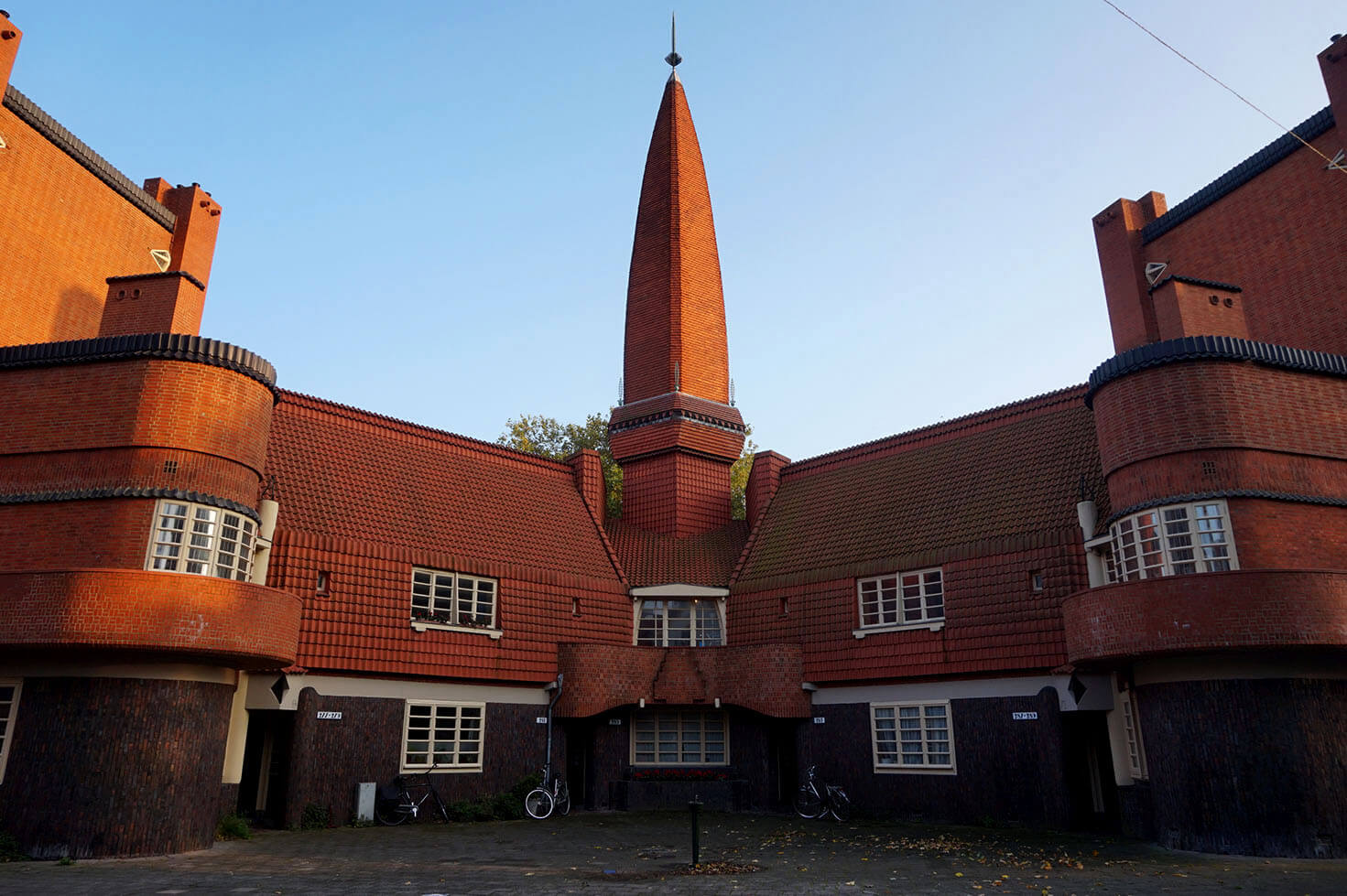
Amsterdam School in the Netherlands
As its name says, the style was born in Amsterdam. According to many, it is the Dutch version of German Brick Expressionism. Only that this style is more Dutch: buildings have more volumes and playful decorations. What they do have in common is the use of brick and organic decorations.
The Amsterdam School style shaped Amsterdam and soon conquered the country. Utrecht, The Hague, Groningen, Haarlem and Wageningen have a lot of Amsterdam School Buildings. Today, you can visit residential buildings, churches, schools, shopping centers, and offices in these cities.
Secessionist Architecture in Budapest
Three things distinguish Budapest from almost any other city in the world: its historic baths, ruin pubs, and Secessionist architecture. Although Secession is a variant of the international Art Nouveau movement, it has several uniquely Hungarian characteristics.
Most Secessionist buildings in Budapest are highly colorful. Inspired by Hungarian folk art and Oriental decoration, they feature undulating forms and an extensive use of ceramic tiles, produced by the renowned Zsolnay factory in Pécs. There are residential buildings, as well as museums, concert halls, banks, hotels, bridges and even a zoo.
