


At the turn of the 19th and 20th centuries, a new artistic movement reshaped European architecture. Known as Art Nouveau, it sought to break free from the historicism that dominated the time.
The style was not uniform, but rather developed in many regional variations. In Spain, it was called Modernismo; in Germany, Jugendstil; in Italy, Liberty. In Austria-Hungary, it was known as Secession.
Hungarian Secession was heavily influenced by local folk motifs and oriental decoration. Many of its buildings were adorned with world-famous Zsolnay ceramics from Pécs. Budapest was the center of the style, where hundreds of Secessionist buildings still exist.

Thonet House
1890
Budapest’s oldest Art Nouveau building, located on Váci Street, is the work of the father of Hungarian Secession, Ödön Lechner. It was built for Michael Thonet, who sold his famous furniture here.
The Thonet House features a relatively conservative design with Neo-Gothic elements. However, ceramic tiles produced in the Zsolnay factory incorporate organic motifs, as does the iron fence on the first floor.

Museum of Applied Arts
1896
Ödön Lechner’s second Secessionist building is considered by many to be his most impressive. It opened in 1896 as part of the Millennium celebrations. It originally housed the Hungarian Royal School of Applied Arts and the museum.
Everything about the Museum of Applied Arts is spectacular. It is easily recognizable by its enormous green-and-gold roof with a large central dome. Numerous decorative elements were inspired by Indian and Islamic architecture.
It is currently closed for renovations.

Liberty Bridge
1896
Another structure opened as part of the Millennium celebrations is the elegant Liberty Bridge over the Danube. Designed by János Feketeházy, it is the shortest bridge in Budapest and is used by both cars and trams.
It is a cantilever structure that imitates a chain bridge. Its wrought-iron frame is decorated with Art Nouveau elements, including Turul birds from Hungarian mythology perched on its four pillars.

Geological Institute
1899
In 1899, another masterpiece by Ödön Lechner was completed: the Geological Institute of Budapest. Originally, the building housed the Geological Society of Hungary, but it later became a museum.
It is remarkable how the architect used decoration to reflect the building’s function. Many elements resemble fossils, alongside abundant folk-inspired motifs. Its lavish roof, covered in blue tiles, can be seen from afar.

Postal Savings Bank
1901
Another impressive work by Ödön Lechner is located just a few steps from St. Stephen’s Basilica. Originally the headquarters of the Postal Savings Bank, it now houses the Hungarian State Treasury.
Once again, the architect drew inspiration from national folk art. The building resembles a giant cake, with curved edges and lace-like decoration. The beehive motifs on the roof symbolize hard work.

National Institute for the Blind
1904
A great place to see Secession architecture in Budapest is the northeastern corner of City Park. Two impressive buildings, the National Institute for the Blind and Teleki Blanka High School, are located here. The former also houses a concert hall, Nádor Terem.
Designed by Sándor Baumgarten and Zsigmond Herczegh, the building blends local and oriental elements. Particularly striking are the decorative brick details around the windows and parapets.

Gresham Palace
1906
Gresham Palace stands in front of the Széchenyi Chain Bridge and is visible even from Buda. Built as the headquarters of the Gresham Insurance Company, it now houses the five-star Four Seasons Hotel Gresham Palace Budapest.
Unlike many Secessionist buildings, it lacks color. However, its flowing shapes, stained-glass windows, ironwork, and floral decorations are exceptional.
You can stay in the hotel or go for a visit.

Turkish Bank
1906
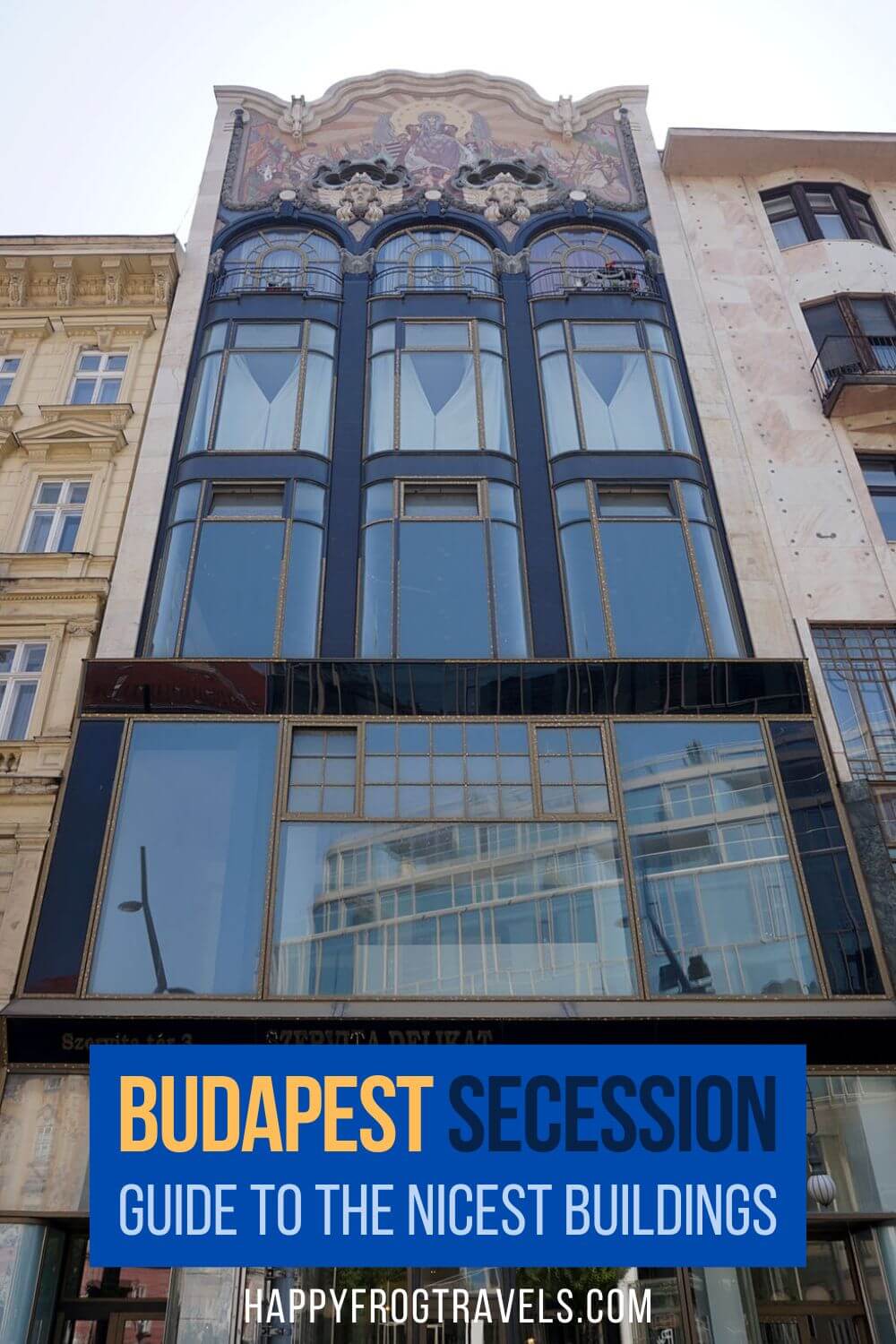
This is my favorite building on the list. Located on a small square in downtown Budapest, it can easily be overlooked. Built as the headquarters of a Turkish Bank, it has since been used for apartments, offices, and shops.
Architects Ármin Hegedűs and Henrik Böhm designed a simple glass façade topped with an impressive mosaic by Miksa Róth. Titled Glory of Hungary, it depicts the Virgin Mary, angels, and Hungarian heroes.

Gutenberg House
1907
A few years ago, I spent a month in Budapest and stayed on charming Gutenberg Square, where my apartment overlooked the lavish Gutenberg House. It was designed to house the Association of Book Printers and Letter Makers, as well as residential units.
It is a symmetrical building with a curved façade and two central gables. Its white exterior contrasts beautifully with decorative ceramic elements in green and yellow.

Franz Liszt Academy of Music
1907
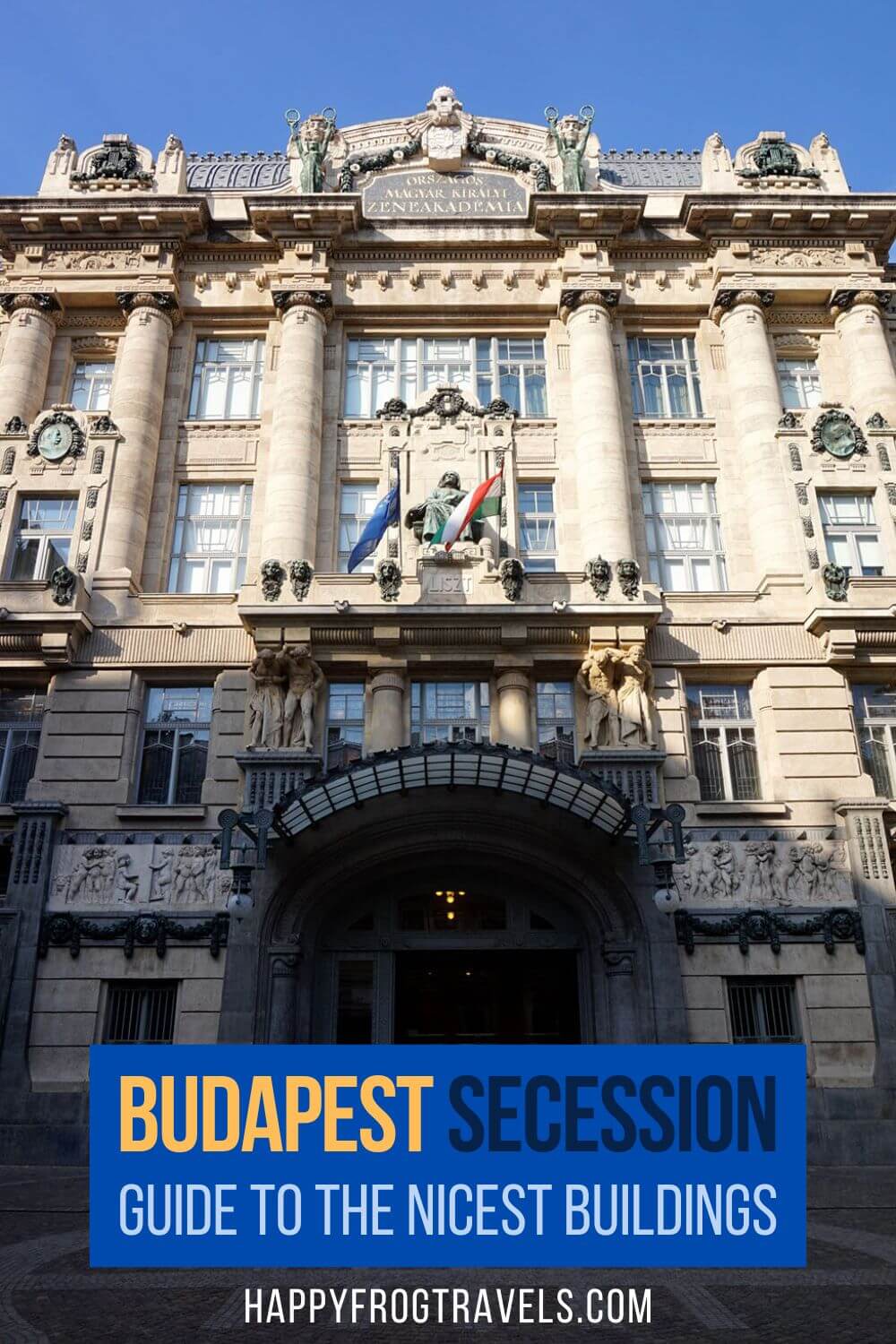
The Franz Liszt Academy of Music stands apart from the other buildings on this list. Its exterior is monochromatic, without ceramic tiles or flowing shapes, resembling Art Nouveau from Austria or France.
The interior, however, tells a different story. The Grand Hall is adorned with golden leaves typical of Viennese Secession, while the main foyer features Zsolnay ceramics and stained-glass windows by Miksa Róth. The highlight is the mural Pilgrimage to the Fountain of Art, depicting a symbolic journey toward artistic inspiration.

Budapest Zoo
1912
One place that contains not just one but an array of Art Nouveau buildings is the Budapest Zoo. Established in 1866, it is one of the oldest zoos in the world. It was extensively reconstructed in 1912.
The main entrance is the most impressive structure, with two stone elephants supporting a colorful arch decorated with ceramic tiles and animal sculptures. The Elephant Pavilion, another impressive structure, is clearly inspired by oriental architecture, resembling a mosque.

Reformed Church of Fasor
1912
The Reformed Church of Fasor combines Secession with architectural influences more common in Germany and the Nordic countries. As a Protestant church, it has a relatively restrained appearance.
It is an asymmetrical structure with two spires of different heights. The main entrance features a large portal above an arched doorway, decorated with hundreds of ceramic tiles bearing Hungarian folk motifs. The stained-glass windows are, once again, the work of Miksa Róth.

Párisi Udvar (Paris Court)
1913
When Párisi Udvar opened in 1913, it was the city’s most impressive shopping arcade. During the second half of the 20th century, it fell into decline and was eventually abandoned. In 2019, it reopened as a luxury hotel, now part of the Hyatt group.
The building is not purely Art Nouveau. It also incorporates elements of Gothic and Moorish architecture. Particularly striking are the glass domes visible from the interior.
You can visit the building or stay in one of its rooms.

Kazinczy Synagogue
1913
Historically, Budapest was home to a large Jewish community. The Kazinczy Synagogue in central Pest was the main temple of the city’s Orthodox Jews. Paradoxically, it was designed in the then-unconventional Art Nouveau style.
What stands out most is its asymmetrical façade and rich decoration. The ochre brick building features semicircular windows, a rosette, and a circular frieze with Hebrew inscriptions.

Gellért Hotel
1918
The final building on this list was completed later than the others. Although construction began in 1911, it opened in 1918 after World War I. It was originally known as Hotel Saint Gellért, named after Hungary’s first bishop.
The exterior is symmetrical and relatively conservative. The interior, however, is richly decorated with Zsolnay ceramic tiles, intricate mosaics, and stained-glass windows.
The Gellért Hotel is currently closed for renovations and is expected to reopen as a Mandarin Oriental property.



Leave a Reply