


Gdańsk is a first-class destination known for its outstanding architecture. Countless medieval houses and palaces stand next to each other on what is called the Long Market, a sort of fascinating main street and square.
A couple of steps away, the largest medieval port crane in the world will amaze you just like the views of the area. Likewise, elegant buildings with ground floor terraces, amber shops, and cool restaurants line Maricacka Street, an intimate corner in the center.
Wait, there’s more! Sopot, Poland’s top beach, is just 15 minutes away and Malbork, the world’s largest castle, half an hour to the opposite direction. Unfortunately, tourist numbers are rising sharply, so visit Gdańsk now, before it gets overcrowded.

Brief History
Gdańsk has quite a unique history. Although its first written record dates back to the late 10th century, the city came into prominence in the 14th century when it was one of the most important cities of the Hanseatic League.
At the same time, it was one of Europe’s main shipbuilding centers. Through the centuries Gdańsk was part of the State of the Teutonic Order, of the Polish Lithuanian Commonwealth, of Prussia, and a free city between the two world wars.
Today, it is a modern city of more than one million inhabitants and one of Poland’s main tourist destinations.

Main Town Hall (Ratusz)
The one building that stands out on Long Market for its size and shape is the Main Town Hall – Ratusz. Built in the late 14th century in the Gothic-Renaissance style, the Main Town Hall has hosted several Polish kings. Once again, destroyed during World War but marvelously restored shortly afterward.
If you think the exterior is gorgeous, wait until you go in and see the magnificent painted ceilings, the wall frescoes, and the delicate furniture. The 83-meter-tall tower contains 37 bells.
Do not forget to climb all the way up the tower for one of the most memorable views of Gdańsk Old Town. Take note that the Gdańsk History Museum is in the town hall.

The Crane (Żuraw)
An obligatory stop on any visit to Gdańsk is the famous old Crane – Żuraw. Originally built in the 14th century, the current one is from 1444. The largest medieval port crane in Europe used to transport cargo and put up musts on ships.
Together with its two adjacent brick towers, it used to serve as a city defense from the river. Men powered the original 2-wheel mechanism that worked until the mid 19th century.
Just like most of the city, the crane didn’t survive World War II. After the war, it was reconstructed and handed over to the National Maritime Museum.

St. Mary’s Basilica (Bazylika Mariacka)
St. Mary’s Church (a.k.a. Basilica of the Assumption of the Blessed Virgin Mary) is one of Gdańsk’s two cathedrals, along with the Oliwa Cathedral. Although historically used as a protestant Lutheran church, it is today a catholic place of worship.
Its enormous size (185,000m2) makes it one of the largest brick churches in the world. Construction began in the middle of the 14th century and ended in 1502. This late gothic building is a triple-aisled hall church with a triple-aisled transept.
The right to eat delicious Polish food will reward those who climb the 405 stairs that lead to the 78-meter-tall tower! Yes, the views are incredible too.

The Armory
The Great Armory building on the western section of the medieval city walls, dates back to the beginning of the 17th century. This jewel of a building is a fantastic example of the so-called Flemish Renaissance style in Poland.
Architect Anthonis van Obbergen modeled it after Haarlem’s Meat Hall. The building served as an arsenal until the 19th century. Between the two world wars, it hosted shops on the ground floor and storage spaces on the upper floors.
It’s a brick structure with sculptural details made of stone. The main (western) façade features a reminiscence of two traditional tenement houses, surrounded by two octagonal stairwell towers.

Amber Museum
Since it is abundant in the sea, the precious stone Amber is also called the Gold of the Baltic Sea. We are talking about 40 million-year-old precious stones! The famous historical amber route started in Gdańsk and went all the way to present-day Italy.
Since 2006 the Amber Museum in Gdańsk is in the XV century Foregate Tower at the beginning of Long Lane. Through its history, the gate served as defense tower, a prison, and a torture chamber.
You can see natural amber and contemporary handcrafts and jewelry in the museum. Not everything is shiny thought. There is a separate exposition of scenes of torture. You can skip that one and climb the viewing platform on the top floor.

Great and Small Mills
Your visit to Gdańsk should take you to the north of the center. The Great and Small Mills built by the Teutonic Knights are the area’s most interesting structures. The two red brick buildings with rising tiled roofs are from the 14th century.
Built in 1350, the Great Mill was the largest industrial building in Europe during the Middle Ages. As with anything European and industrial, slaves powered the 18-wheel mill until 1356, when replaced by the nearby canal.
It continued to function as a mill until World War II. It was then converted into a shopping center and is soon to become a residential building.

Other Historical Buildings
Gdańsk is arguably the nicest city on the Baltic Sea and the one with the most historic architecture. These are the result of the city’s rich history, political importance, and the use of slaves.
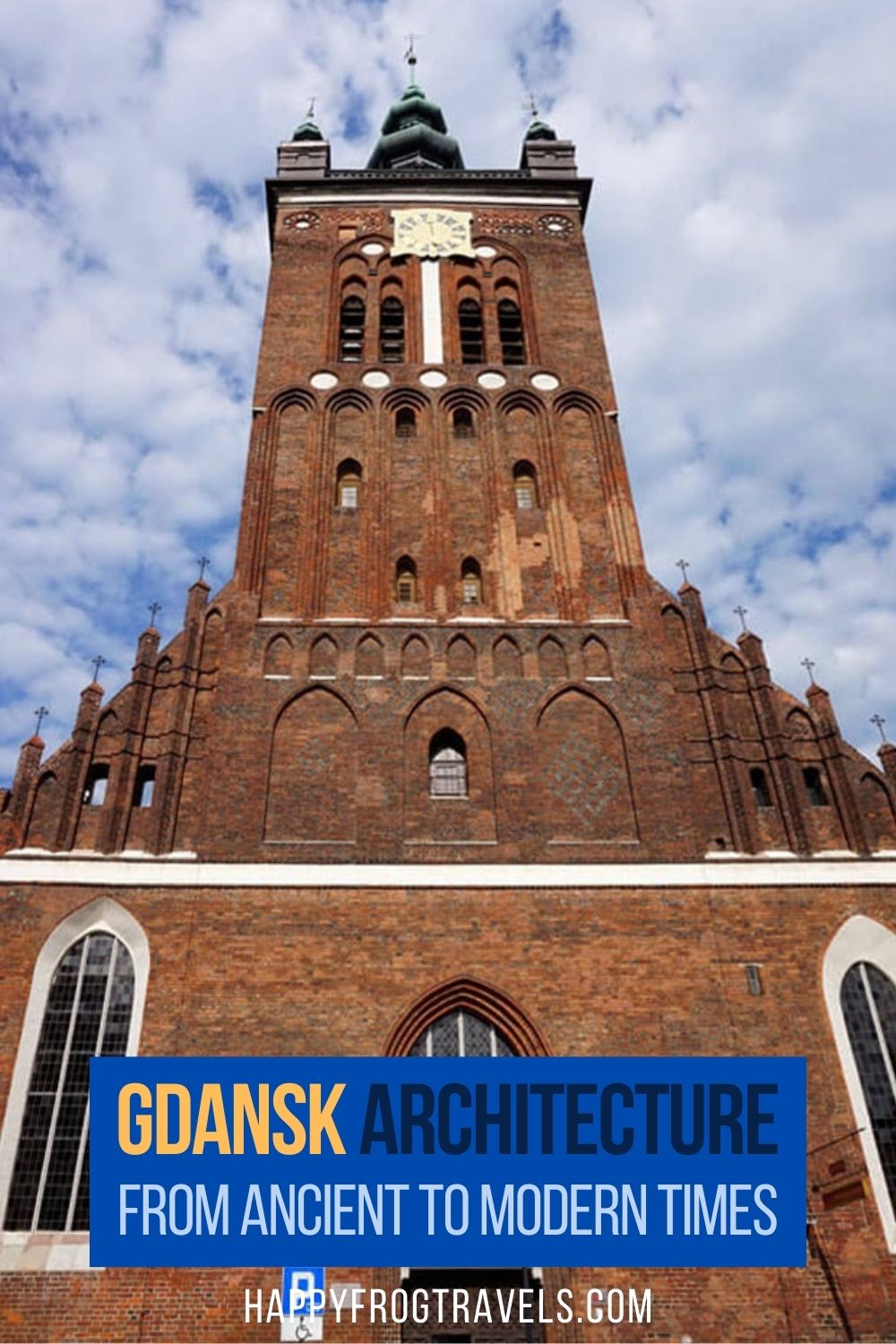
Our favorite medieval church is St. Catherine’s Church. The early 13th-century Gothic church is Gdańsk’s oldest.
Another cool structure is the Main Market Hall from the late 19th century, a neo-baroque red brick structure.
The nearby Gdańsk Główny railway station is from the same period, and you should visit it even if not traveling from there.
Near the train station, you’ll find another one of Gdańsk fantastic attractions, the Old Town Hall. Built in the 16th century in the characteristic renaissance style, it survived the war almost intact.

Contemporary Architecture
Not everything is old in Gdańsk. There is plenty of cool contemporary architecture in the city too.
The Gdańsk Shakespeare Theatre is the only theater in Poland based on the tradition of Shakespearian theaters. It is in a building known as the black box, located on the site of a 17th-century theater.
The European Solidarity Centre is a museum dedicated to the history of civil resistance movements across Eastern Europe. Take note of the building, which resembles ships built at the nearby shipyard.
Another cool contemporary building is the Museum of the Second World War.

Where to Stay
Tourism in Gdańsk has grown significantly in recent years, and so has its accommodation offer. However, it seems that private tourist apartments are the accommodation of choice in Gdańsk. They are everywhere!
We stayed at the charming CITYSTAY miniLOFT Gdańsk. Located on the Granaries Island, just across the old town, it is a great place to discover the city.
If you are looking for something a bit more central, stay at the Apartamenty Chleb i Wino.
If you prefer to stay in a hotel, you should pick the Scandic Gdańsk, conveniently located in front of the train station.



Leave a Reply