


Paris has Parc de la Villette, Singapore has Gardens by the Bay, and Barcelona has Parc del Centre del Poblenou. These three parks are among the most extraordinary examples of park architecture.
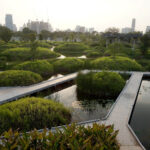
Poblenou’s central park is one of the most unique parks in Barcelona. What makes it so special is its creative use of plants and street furniture. Moreover, sunny and shaded areas blend perfectly in this colorful park.
One thing I love about this park is how local it feels. Its location in the industrial district of Poblenou has somehow protected it from mass tourism. Hopefully, this post won’t change that.

The Background
Parc del Centre del Poblenou, just as its name suggests, lies in the heart of the historic Poblenou neighborhood. Until 1897, it was a separate town and a major center of Catalonia’s textile industry.
In the second half of the 20th century, most of the industrial facilities closed, and the whole area felt abandoned. It remained that way until the 1990s, when Barcelona was preparing for the Olympic Games. During that period, an independent art scene flourished here, including some of the city’s best street art.
In 2000, the Barcelona City Council approved the so-called 22@ plan, aimed at transforming 200 hectares (500 acres) of industrial land into a modern mixed-use district. The park was part of that initiative.

The Project
In 2001, the city of Barcelona organized a competition to design a central park for Poblenou. The renowned architecture studio Ateliers Jean Nouvel won and subsequently created the park’s design.
The project’s main idea was to create a park that would be sunny in winter and full of shade in summer. Irrigation is provided by a large reservoir that uses groundwater.
The park’s triangular shape is determined by the three streets that surround it: Carrer del Marroc to the northwest, Carrer de Bac de Roda to the northeast, and Avinguda Diagonal to the south. Two other streets divide the park into three main areas. A large concrete wall wraps around each of them.

Area No.1
The area west of Carrer d’Espronceda is the largest. It is also the one with the sparsest vegetation. At its western end is a pneumatic waste collection plant. Its roof forms an artificial mountain covered with sand and rocks, simulating a lunar landscape.
The center of this area is occupied by a circular plaza, 32 meters (105 feet) in diameter, called Sardana Square, where locals are meant to practice the traditional Catalan dance. Several tall weeping willows surround the square.
To the northeast, there is a small square with a metal dome and laurel trees. Next to it stands the Xemeneia de Buigas i Samsó, a remnant of the area’s industrial past.

Area No.2
The area east of Carrer d’Espronceda and north of Carrer de Cristóbal de Moura is the second largest. It has the shape of a square, cut diagonally by the old Trafalgar–Sant Martí tram line, which continues into Area No. 1.
This area’s centerpiece is a former machine factory that was converted into a museum. The building was facing demolition during the park’s construction, but it was saved by a neighborhood association. Since 2020, it has housed the Barcelona History Museum Oliva Artés.
The area south of the museum is shaded by many trees. There is also a section with aromatic plants and a children’s playground. North of the museum, there is even a police station.

Area No.3
The final area is a triangular section south of Carrer de Cristóbal de Moura. This is the part of the park with the densest vegetation and the greatest amount of street furniture.
An interesting piece of land art occupies the southwestern corner of this area. Known as the Well of the World, it is a crater surrounded by a spiraling dirt path and bougainvillea.
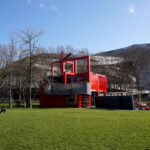
To the east, there is a dense forest of Peruvian pepper trees, along with several large sculptures in geometric forms. Known as the Nests and Wells of Heaven, they pay tribute to Antoni Gaudí.

Street Furniture
One of my favorite things about this park is its beautifully designed street furniture. Numerous details, including benches, lamps, pergolas, and fences, are made of silver-colored metal with round perforations.
Among the most iconic elements are the so-called Bouquets, a series of vertical structures that serve as flowerpots. Other notable features include sculptural metal benches and spherical lamps.
The entire park is enclosed by concrete walls covered in climbing plants. These walls contain circular windows decorated with bird motifs. The entrance gates were inspired by the gate of Finca Miralles.

Where to Stay near the Park
If you plan to spend some time in the park, you may want to stay nearby. Numerous first-class hotels have opened in Poblenou in recent years. In fact, this is one of the best areas to stay in Barcelona.
The wonderful Meliá Barcelona Sky is the most obvious choice. This sleek four-star property features stylish rooms, an outdoor pool, and a spa. Some rooms even overlook the park.
Labtwentytwo Barcelona, a Tribute Portfolio Hotel is located in the recently refurbished block right next to the park. It is a design hotel offering comfortable rooms and spectacular views.

Where to Eat and Drink
If you get hungry or thirsty, there are plenty of excellent options nearby. Sports Bar Menjar Italià, across Avinguda Diagonal, serves superb Italian food, including Neapolitan pizza, lasagna, and Sicilian cannoli.
One block away, Buenos Brasas Grill offers some of the best Argentine barbecue in the city. It is known for tender steaks, slow-grilled meats, black pudding, empanadas, and provoleta cheese.
If you would rather try local cuisine, head to L’Artesana Poblenou. They serve traditional Spanish and Catalan dishes with a modern twist. I recommend ordering paella or sampling some of their delicious tapas.



Leave a Reply