


If you are planning a trip around Western Europe, Amsterdam or Paris are surely on your list. At the same time, you’ll probably be wondering: is Brussels worth visiting?
Located halfway between these two remarkable cities, it is somehow under their shadow. But there is something undeniable that makes Brussels a fantastic place: Belgium’s capital is Western Europe’s most multicultural city.
Surrounded entirely by Dutch-speaking Flanders, it has gradually adopted French as its main language. Today it is an independent region, the seat of the European Union and NATO, and home to people from all over the world.

What is Brussels Like
Brussels is a fairly large city with more than 1 million inhabitants, yet most of its important landmarks are in a small area within a ring made of boulevards.
The famous Grand Place / Grote Markt square, in the very center of said area and a UNESCO World Heritage Site, is the city’s main attraction. We are talking about over 30 guildhalls next to each other, including the impressive Town Hall and King’s House.
The area around the square is full of narrow streets, historic buildings, street art and some of Brussels Best Chocolate Shops. To the south, you will find numerous monumental public buildings that lead to the European Quarter, where most of the European Union institutions are.

Why Visit Brussels
Grand Place
The famous Grand Place is Brussels central square. Most visitors begin their walk around Brussels here. The existing structures date back to the end of the 17th Century and are faithful copies of the original gothic, renaissance, and baroque buildings.
The majestic Town Hall, with its 96-meter tall tower, dominates the cityscape and can be seen from afar. The Town Hall is one of the best examples of Brabantine Gothic and the only medieval building that remains in the city.
Across from the Town Hall, you will find another remarkable building: the so-called King’s House, built atop an ancient bread market. The house’s been reconstructed several times and is now the Brussels City Museum. Its current appearance is from the late 19th Century.

Peeing Statues
The Grand Square is undoubtedly one of Brussels’ main landmarks. Nevertheless, someone else made the city famous: the tiny Manneken Pis. You must visit it even if you only have 3 days in Brussels. The bronze statue of a boy peeing represents the irreverent spirit of Brussels.
The current statue is from 1968. The original one, from the early 17th Century, is in the Brussels City Museum. Numerous anecdotes and legends surround the sculpture, including one in which boy Duke Godfrey III urinates on the attacking troops, bringing victory to his army.
But Brussels has more than one peeing statue. In 1987 a counterpoint sculpture was erected nearby. The Jeanneke Pis represents a little girl doing exactly the same thing: peeing! There is even a sculpture of a dog peeing: the Zinneke Pis.

Mont des Arts
Another interesting square you shouldn’t miss is the elegant Mont des Arts, Brussels Art Square. The elegant modern square is from the 1960s and features two large buildings housing a library, a convention center, and an archive.
The small green garden between the buildings is a masterpiece of landscape architecture. The square offers brilliant views of Brussels.
Don’t forget to go to the upper section of the square to check a couple of interesting museums, including the Old England (Musical Instruments Museum). In our opinion, the latter is the city’s nicest art nouveau building.

Royal Square and Palace of Brussels
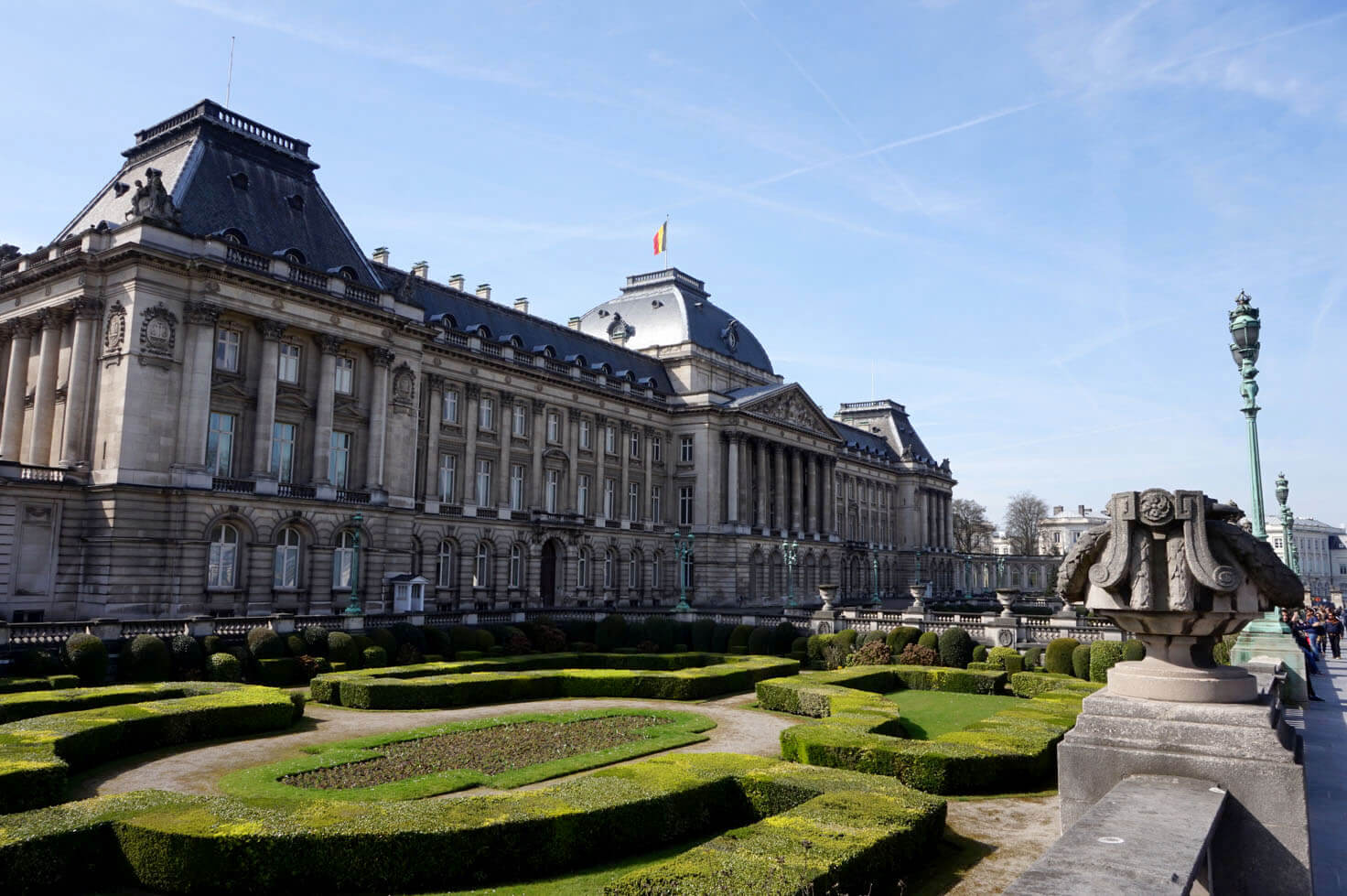
If you are into monumental architecture, Brussels is your place. Right next to the Mont des Arts, the Place Royale (Royal Square of Brussels) is a neoclassical square surrounded by courts, museums, and a church.
The 18th-century square stands where the former royal palace market was. The current Royal Palace of Brussels, the official palace of the Royal Family, is behind the square.
The family doesn’t live there, but they use it to welcome guests, such as presidents and ambassadors. The palace has a large collection of royal portraits and furniture that belonged to historical figures, including Napoleon.
Atomium Building
One building that has put Brussels on the world architecture map is the iconic Atomium. Just seeing the Atomium building makes Brussels worth visiting.
Built for the International Exhibition of 1958, its nine spheres represent the iron crystal cell. Ironically enough, aluminum was the original material used. During the latest reconstruction, the stainless steel we see today was added.
Six of the nine spheres are open to the public. They house galleries, events rooms, a restaurant, and a children’s room. As you can imagine, the views from the highest sphere are unforgettable.

Historic Churches
Every tour around Brussels must include its interesting religious landmarks. The largest and the most distinguished one is the Cathedral of St. Michael and St. Gudula. It took more than three centuries to finish this gothic church, but the result is impressive.
Another church not to be missed is the Our Blessed Lady of the Sablon. The 15th Century church is a great example of Brabantine Gothic, with richly decorated interiors and exteriors.
One of our favorite churches in Brussels is 3 kilometers northwest of the center. The National Basilica of the Sacred Heart in Koekelberg is the largest Art Deco church in the world.

Art Nouveau Buildings
By the turn of the century the world was about to give birth to a new form of architecture, a modern one. In 1893 Brussels, the Art Nouveau style came to light. It was all about unique decorations with new materials, colors, and shapes.
It was so well received at the time, that it quickly spread all over Europe. In Barcelona Art Nouveau was named Catalan Modernism, while in Budapest and Vienna, Secession.
Besides being the birthplace of the style, Brussels homes some of the best examples of Art Nouveau architecture in the world. Our favorites are the Old England Building, Solvay House, Horta Museum, Cacuchie House, and the Saunt Cyr House.

European Quarter
East from the Grand Square, along Rue Belliard and Rue de la Loi, we find the modern European Quarter of Brussels. Brussels is the capital of the European Union, thus home to many important institutions.
It’s an interesting neighborhood, with slick hi-tech architecture and an international vibe. Probably the most famous building is Berlaymont, home of the European Commission, the EU’s executive branch.
Nevertheless, the liveliest part of the area is the Place de Luxembourg, where the European Parliament is. It’s a great mixture of old and new. And we are not only talking about architecture!

Numerous Interesting Sights
If you think this is all Brussels has to offer, you are wrong! Interesting sights pack the whole area inside Brussels ring. Just 100 meters from the Grand Square, the Brussels Stock Exchange is a popular meeting point.
Another interesting neoclassical building is the eternally under construction Palace of Justice of Brussels. You’ll easily recognize it from its characteristic tall tower.
Les Galeries Royales Saint-Hubert is a colorful shopping center, one of the city’s oldest. Notice the glazed arched roof that covers the elegant building. If you are into old fortresses, visit the monumental Halle Gate, a medieval fortified gate.
If you still didn’t have enough, check out this post for other Brussels attractions.

Gorgeous Parks
It’s pretty clear that architecture in Brussels is beautiful, but there are several outstanding parks too. Our favorite one is right behind the European Quarter. King Leopold II commissioned the beautiful Parc du Cinquantenaire together with the attached monumental buildings for the national exhibition of 1880.
Inside the European Quarter, we enjoyed spending time in Parc Léopold. Though smaller, it doesn’t lack character. Parc de Bruxelles is the largest park in the city center. It used to be the hunting grounds for the Royal Family.
If you have extra time, visit some of the city’s peripheral parks, such as the Malou Park and the Bois de la Cambre.

Stunning Street Art
Brussels is one of Europe’s street art hotspots! Graffiti, murals, and other public art pieces pepper the Belgian capital. In fact, quite a few have achieved world fame.
Some of them pay tribute to Belgian cartoon characters. Hence, you can see works dedicated to Tintin, Lucky Luke, Spirou, The Smurfs, and Corto Maltese. Others are allegories to famous Brussels landmarks, like the Manneken Pis.
Of course, there are also murals covering LGBT+ topics. No wonder, since Brussels is at the forefront of gay rights. There are even large murals with explicit sexual characters, including a woman having fun!

Wonderful Day Trips
Belgium is a pretty small country packed with beautiful historic cities and towns. The nicest ones are in Flanders, ideal for day trips from Brussels. Bruges is the country’s most famous medieval town, a remnant of the once-thriving Hanseatic League. Every street, square, park, and building tells the story of this historic city. If you visit you have to take a Bruges canal tour.
Ghent, on the other hand, may not be that popular, but it is equally, if not more, beautiful. Its colorful festival Gentse Feesten is an ode to great music and art. It should be on any itinerary around Belgium.
Even the country’s second-largest city Antwerp makes for a great destination. And not only for the diamonds! Finally, let’s not forget about the beautiful Lille in France.

Chocolate, Waffle and Beer
We’re not going to say that Belgium is home to the best food in the world. After all, it’s not Italy or Greece. But a few things have put Brussels and the rest of Belgium on the world’s food and drinks stage: chocolate, waffles, and beer!
Many people believe Belgian chocolate is the world’s best. Funny though how the origin of the chocolate (as the people who grow it) is not relevant. Just try pralines or truffles and you’ll know what we are talking about.
The waffle is another famous Belgian product. In fact, Brussels has its own variation. They are usually lighter and crispier than other European waffles. No wonder you can find them literally everywhere. Just try not to get dirty as we did!
Of course, you can’t leave Brussels without trying some of its numerous beers. The Belgian beer culture is so special that UNESCO included it in its list of intangible cultural heritage.

Fantastic Hotels
Compared to other major European capitals, Brussels is a relatively inexpensive city. In fact, mostly visited by officials and executives, hotel prices drop dramatically during weekends. The best location to stay in Brussels is the historic core, not far from the Grand Place.
There are plenty of hotels south and east of the ring, especially in Ixelles and around the European Quarter. We stayed at the wonderful Pantone Hotel in Ixelles. This colorful hotel offers design, comfort, and grand terraces. We loved the views from ours!
If you want to stay inside the ring, the Motel One Brussels is the place for you. Located next to the cathedral, it offers comfortable rooms and again great views. Another great option next to the Grand Place is the Novotel Brussels City Centre.


Leave a Reply