


When you think of Bangkok, its lavish palaces and colorful temples come to mind. Indeed, the Thai capital is home to some outstanding historic architecture.
However, Bangkok is so much more than that. The unique architectural style known as Brutalism reached the city in the 1960s. During that decade and the one that followed, several outstanding examples of the style were built.
Most Brutalist buildings in Bangkok are public. Several large universities host buildings in this style. There are also private houses, office buildings, and even a cool café.

Lecture Hall of the Faculty of Science, Mahidol University Phayathai
1965 Amorn Sriwong
The oldest Brutalist building in Bangkok is colloquially known as Tuek Kom, or the Round Building. Its circular shape and spaceship-like appearance were quite unusual for the city at the time.
Its structure is made of reinforced concrete pillars with stone bases. Twelve concrete beams form the circular ceiling of the first floor. Between them, the concrete is left exposed, showing traces of the casting process.
The building contains five large lecture rooms, the largest of which seats 500 people. I especially loved the open space beneath the building, perfect for resting in the shade on a hot day.

Physics Building, Kasetsart University
1969 Ong-ard Satrabhandhu
The first fully Brutalist building in the city was built in 1969 to house the Faculty of Physics at Kasetsart University. It is a relatively small structure located in the middle of the campus.
The main volume is rectangular, with paneled openings resembling balconies. The highlight is a large protruding lecture hall that cuts diagonally through the main volume. There is also a pedestrian ramp and a cylindrical staircase.
The building contains classrooms and research laboratories. The main lecture hall, located in the protruding volume, can host more than 250 students.

Faculty of Commerce and Accountancy, Thammasat University
1969 Amorn Sriwong
The same architect who designed the lecture hall at Mahidol University also created this building in Bangkok’s Old Town. Thanks to its unusual openings, it has earned the nickname The Fish Building.
Unlike most buildings on this list, this one does not prominently expose concrete elements. Instead, its distinctive appearance comes from the shape of the window openings.
Another interesting feature is its diagonal reinforced concrete structure, quite unusual for Thailand. Several departments are housed here, including finance, accounting, marketing, and international business.

Siri Apartment (Kasemsan Mansion)
1970 Dan Wongprasat
The Siri Apartment building, originally known as Kasemsan Mansion, is perhaps Bangkok’s most unusual residential building. Its architect was a student of Louis Kahn, whose influence is clearly visible.
The round building resembles a giant octopus. Twelve slim cylinders housing stairs and elevators surround the central core of apartments. A circular opening on the roof provides light and ventilation, while recessed spaces help reduce direct sunlight.
As this is a private residence, access is limited. Instead, you can take the narrow car lane next to the Okura Hotel to view the building from the side. You can also go up to the hotel’s lobby (on 24th floor) to see it from above.

Faculty of Veterinary Science, Chulalongkorn University
1972 Rangsan Torsuwan
Rangsan Torsuwan is one of Thailand’s most renowned architects. His first Brutalist work, Faculty of veterinary Science at Chulalongkorn University, is bold and expressive.
The building resembles a massive stepped structure, with progressively wider upper floors. Perpendicular concrete walls create a strong interplay of light and shadow across the façade.
Inside, the building houses lecture rooms and offices. I managed to visit, though I was slightly disappointed that many interior surfaces had been painted over.

Kamol Sukosol Electric Co.Ltd.
1972 Rangsan Torsuwan
Tucked away in a small alley right next to the beautiful Ong Ang Canal, the Kamol Sukosol Electric building serves as Mazda’s office and warehouse.
Torsuwan’s second Brutalist work is even bolder. Its sharp vertical lines give it an almost Gothic-like appearance, while the interplay of light and shadow is even more pronounced.
Originally, the building housed the only Mazda dealership in Thailand. Supposedly, it still functions as a Mazda warehouse, but when I visited, it appeared abandoned.

Electricity Generating Authority of Thailand (EGAT)
1972/1987 Sittart Thachalupat and Interproject
If you want to visit a Brutalist building and only have time for one, I suggest heading directly to the Electricity Generating Authority of Thailand (EGAT) in Nonthaburi. It’s a large complex, and several of its buildings are Brutalist.
Two main volumes run parallel to each other, forming a pedestrian street between them. Basic geometric forms dominate the composition: cubes, circles, and triangles appear throughout. Some of the Brutalist buildings were completed in 1972, while others date from 1987.
Like most public institutions in Thailand, the complex is open to visitors. The public space surrounding the buildings is so pleasant that I wasn’t surprised to see many locals resting, socializing, or exercising.

Three Column House
1975 Nitt Charusorn
Of all the buildings on this list, this one is my favorite. What I love most is how its reinforced concrete elements serve both structural and decorative purposes. The Three Column House truly celebrates concrete.
Although the initial design included four pillars, the architect removed one so it wouldn’t block the view of his parents’ house across the yard. To make this work, the remaining pillars had to be massive, connected by an equally strong beam that carries the load.
Diagonal beams further reinforce the structure and give the house its distinctive character. Note that this is a private residence, so access is restricted. It’s not located directly on the street, but rather on a hidden plot at the end of a small lane.

Bangkok Mail Center
1985 Architect unknown
I discovered this building while traveling to Lopburi from Hua Lamphong Train Station. The Bangkok Mail Center is located on Rong Mueang Road. Though largely in poor condition, it still retains its clear Brutalist lines and has never been painted over.
The most distinctive elements of this unique building are the vertical panels that provide shade on its western side (the side you see from the train). While most of the building is covered in raw concrete, the stairs and elevators are painted yellow, and there are purple panels for the ramps that accommodate parcels.
When it opened in 1985, it was the most modern postal facility in Thailand, handling millions of packages every day. Since then, it has gradually been abandoned, and currently, only the first floor still has some activity. You can visit the building on special occasions.

Patchworks Dessert Café
2024 party / space / design
The latest addition to this list is actually quite recent. Brutalism flourished in the 1950s, 60s, and 70s, but in the last decade there has been a modern revival of the style. It even reached Bangkok in 2024 with the stunning Patchworks Café.
This building takes a very different approach to Brutalist aesthetics. Here, concrete acts as a raw canvas, with every imprint of the wooden formwork clearly visible. It is then enriched with window openings, a metal flower on the corner, and even a tree on the rear façade.
Patchworks is a café serving a variety of coffees and a wide selection of cakes. It has two main levels, with beautiful details completing the space.

Other Buildings Celebrating Concrete
After extensive research, these were the only ten buildings I found in Bangkok. However, many online sources mention others. While those buildings do use concrete as both a structural and decorative element, they are painted, so technically, they are not Brutalist.
Two buildings associated with the Thai Islamic community deserve a mention. One of them, the Libya Building, features an interesting play of window openings. The other, the Foundation of the Islamic Centre of Thailand, has striking concrete canopy roofs. Both are works by Paichit Pongpantuk.
Another building I love is the Penang Silk Screen Printing House Company Limited. It combines brick and concrete, with distinctive balconies featuring rounded edges. Then there is the Nightingale-Olympic Mall, Bangkok’s oldest department store.
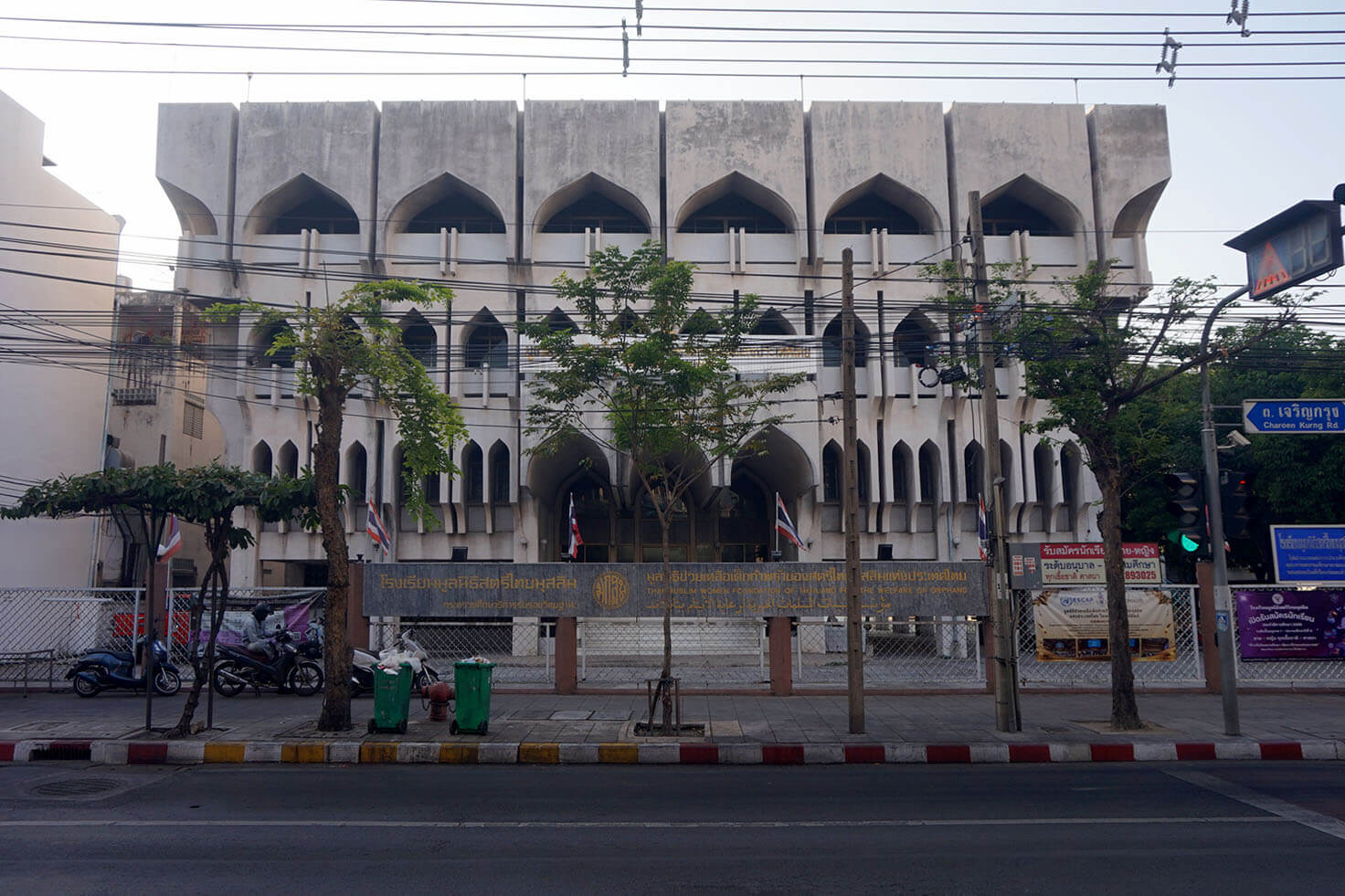
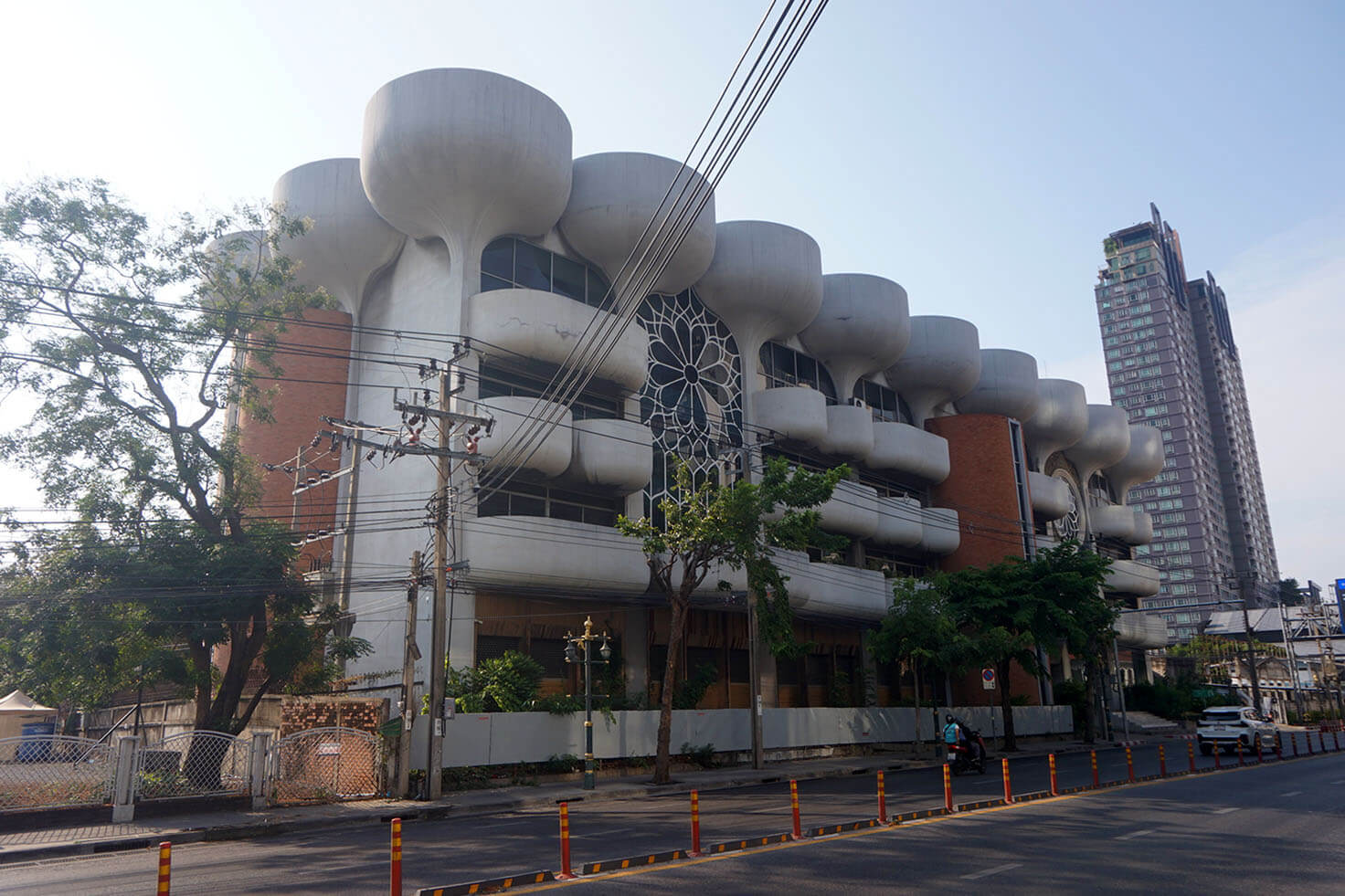


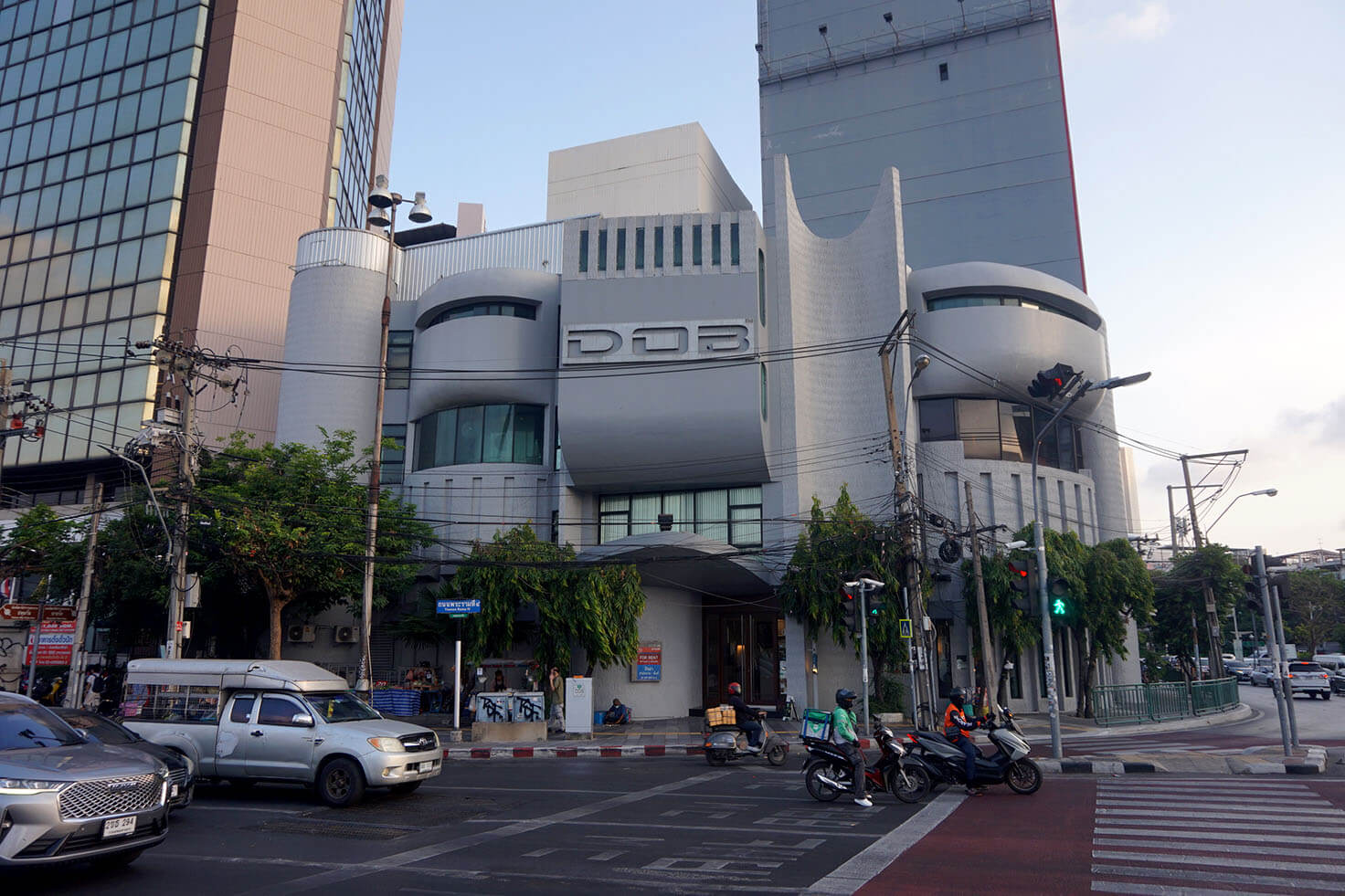

I would also like to mention the DOB Building, across from Hua Lamphong Train Station, for its spaceship-like appearance, as well as the Samphanthawong District Office in Talat Noi, known for its expressive use of concrete on the façade.
Finally, it wouldn’t be fair to end this post without mentioning several impressive bank buildings that beautifully showcase the use of concrete. Some of my favorites are the Krungthai Bank on Yukol 2 Road and the Kasikorn Bank on Mahachai Road and Itsaraphap Road.
If you’re looking for a Brutalist place to stay, unfortunately, no hotel in Bangkok was built in this style. However, the Sindhorn Kempinski Hotel features an impressive Brutalist entrance and is a fantastic place to stay.


Leave a Reply